


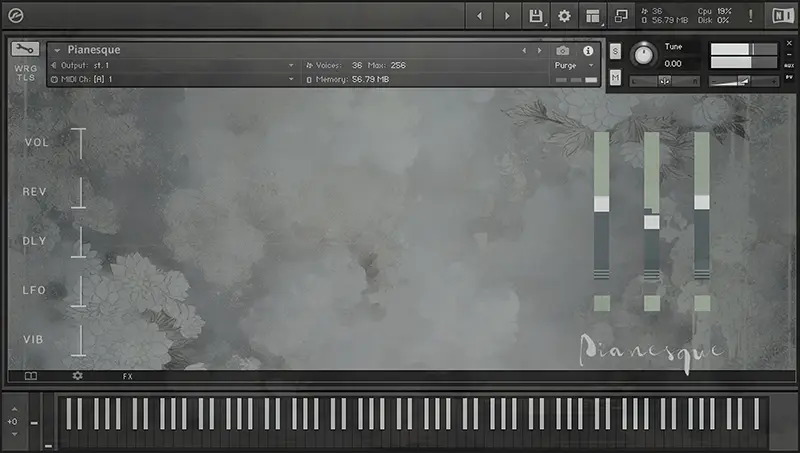
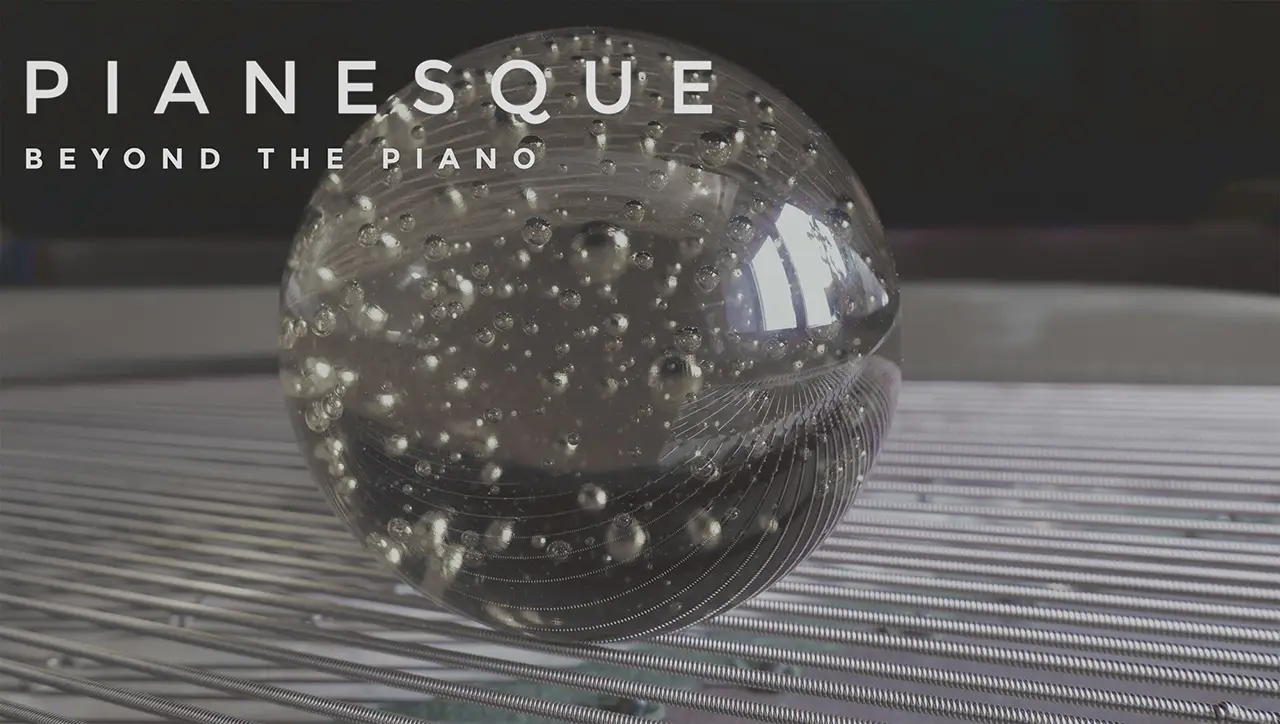



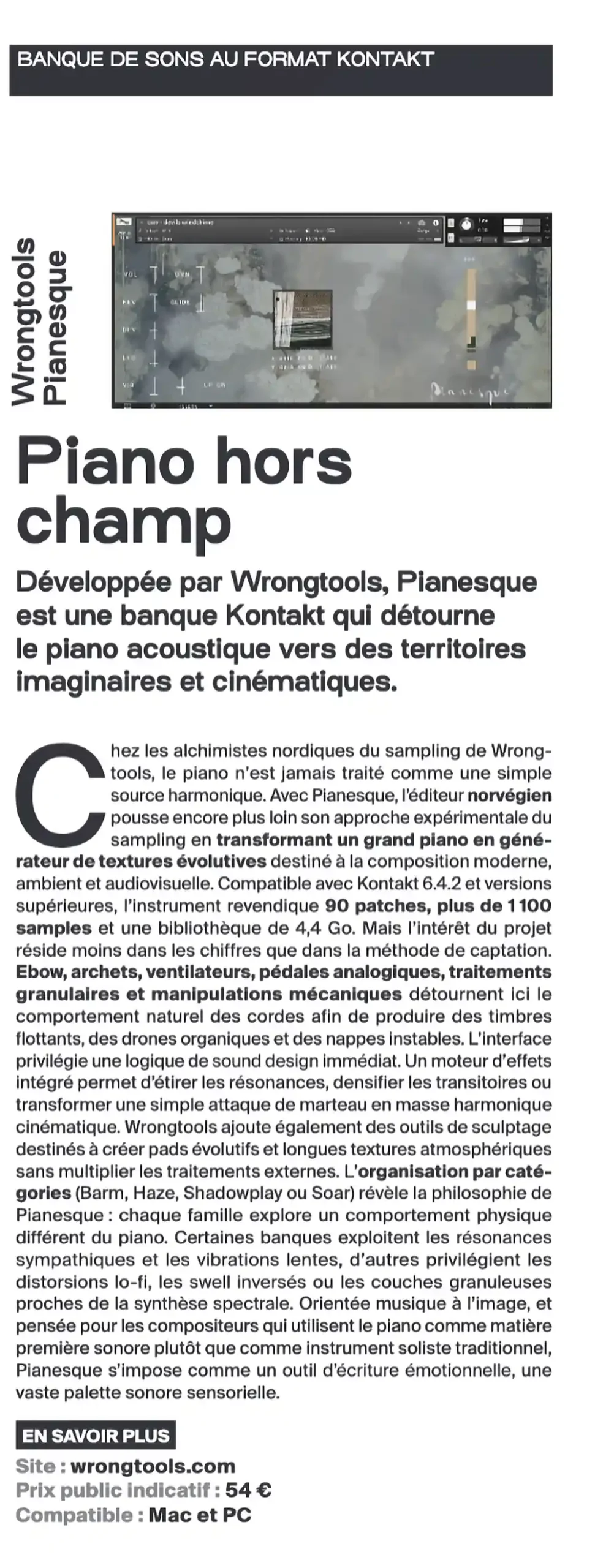
PIANESQUE begins where the hammer leaves the string.
 A Piano kontakt library built from unconventional interactions with grand piano using e-bows, bows and other manipulation tools, plus granular processing, tape colour and experimental signal chains
Built from ebows, bows, and quiet acts of interference, PIANESQUE
stretches the instrument beyond its physical limits:: into long-form
textures, dissolving harmonics, and unstable beauty.
A Piano kontakt library built from unconventional interactions with grand piano using e-bows, bows and other manipulation tools, plus granular processing, tape colour and experimental signal chains
Built from ebows, bows, and quiet acts of interference, PIANESQUE
stretches the instrument beyond its physical limits:: into long-form
textures, dissolving harmonics, and unstable beauty.
A Piano kontakt library built from unconventional interactions with grand piano using e-bows, bows and other manipulation tools, plus granular processing, tape colour and experimental signal chains
Built from ebows, bows, and quiet acts of interference, PIANESQUE
stretches the instrument beyond its physical limits:: into long-form
textures, dissolving harmonics, and unstable beauty.
Category: experimental piano / cinematic textures / piano sound design
Best for: modern scoring, emotional atmospheres, ambient, abstract piano textures, cinematic shadowplay
Character: weightless, drifting, resonant, shadowy, textural, atmospheric
Number of instrument patches: 90
Size: 4.6 GB
Related products: Putty Grand, Mule Piano, Vinyl Piano, Tangent
It contains a rich specter of long-lasting pianotimbres with emotional depth and detail.
You may for example create ethereal, evolving textures, or shape those intimate or massive atmospheric layers. Or play with the patches that you can hear are from a piano, in a piano-way. with depth and realism
It includes a big collection of recorded sounds that can function as subtle undercurrents or immersive sonic environments – on top – or within a broader score.
PIANESQUE pairs particularly well with evolving string libraries such as Jasmine and Osmosis
Yes! Pianesque contains a rich specter of long-lasting pianotimbres with emotional depth and detail.And you’ll find it easy to blend it into your music. A cool thing we’ve used alot is to double it with other piano libraries. The soft and rich sounds in Pianesque makes it a really cool tool to support other libraries. like shadowplay…
It can also be used as a tool for sound design. It provides elements that are both acoustically organic and subtly abstract, facilitating the construction of pretty different kinda soundscapes.
Through play and experimentation. We used everything from guitar pedals and speakers to rotating fans and percussive striking. It is a wide, coherent palette of experiments that blur the line between acoustic instrument and synthesized soundscape.
In the library you’ll find :
- cinematic piano sounds
- ambient piano textures
- evolving piano textures
- atmospheric piano layers
- granular piano-rivers and evulations
- emotional piano sounds
- film scoring pianoshadows, great for blending under other piano libraries
- modern classical piano textures
- experimental piano textures
PIANESQUE is designed for composers searching for evolving piano textures rather than traditional piano performances. Instead of focusing on percussive attacks, the library explores resonance, decay, movement, instability, and atmosphere.
It is for music producers who like to layer sounds, or that are simply looking for a different starting-point. Something to trigger inspiration and to bring them down another path. It is blurring the boundaries between piano and sound design.
PIANESQUE was created for:
- film composers
- ambient producers
- game composers
- modern classical writers
- minimalist composers
- sound designers
- trailer composers
- seeking organic textures
It is compatible with the retail version of Kontakt version 6.4.2 and up. (that includes Kontakt 8 and onwards…)
A golden trick :
We keep layering PIANESQUE underneath other pianos.
—-—-—-—-—-—-
How to Set It Up
Take your favorite piano library.
This can be a felt piano, a cinematic grand, an upright, a prepared piano, or even a bright pop-style piano that needs more emotional weight.
Then load PIANESQUE beneath it.
Do not start by looking for the biggest patch. Start with something that has a stable emotional tone: a soft haze, an ebow-derived sustain, a slow current, a shadowy texture, or a warm granular layer.
Then follow the piano part in one of three ways:
1. Root-note doubling
Let PIANESQUE follow only the bass notes or harmonic roots. This gives the piano more gravity without crowding the arrangement.
2. Chordal shadowing
Let PIANESQUE play the same chords as the piano, but quieter and possibly with fewer notes. This creates width and emotional continuity.
3. Selective emotional entry
Let PIANESQUE enter only on important harmonic moments. This is often the most cinematic approach. The layer appears when the scene needs pressure, memory or tenderness.
The goal is not constant thickness.
The goal is controlled reinforcement.
——
From an orchestration point of view, this is not very different from doubling a melody with another instrument at a low dynamic.
A flute doubled quietly by a clarinet changes color.
A cello line doubled by contrabassoon gains gravity.
A string harmonic doubled by soft electronics becomes suspended in a different kind of air.
The same principle applies to piano.
The main piano provides definition: attack, rhythm, voicing, touch.
The lower layer provides continuity: sustain, warmth, undertone, emotional glue.
-


Bell-tone piano
€28 -
Celesta Duet
€28 -
Dulcitone Pro
€48 -
The Silk Rhodes
€28 -
Mule Piano
€78 -
Pianesque
€54 -
Vinyl Piano
€38 -
Pianotron
€28 -
Putty Grand
€78


Updating…